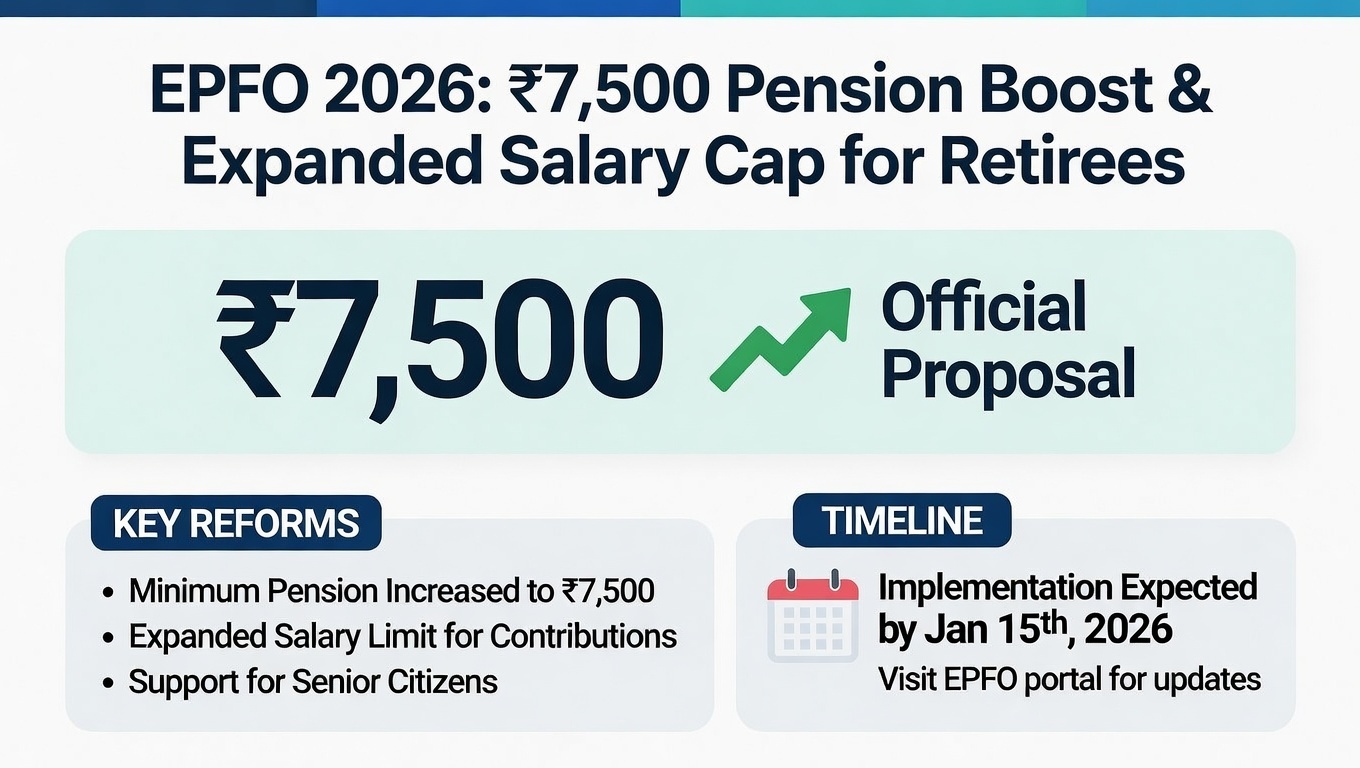
The EPFO Pension 2026 update has once again brought retirement security into the national spotlight. For years, private sector retirees covered uner the Employees’ Pension Scheme (EPS) have struggled to manage daily expenses on a minimum pension of just ₹1,000 per month. In 2026, discussions around increasing this amount to ₹7,500 have gained momentum, reflecting growing concern about inflation, healthcare costs, and the dignity of senior citizens. These discussions are taking place at the policy level and involve inputs from pensioner associations, economists, and government officials.
The proposal also includes revising the pensionable salary ceiling from ₹15,000 to ₹25,000 per month. This move is seen as an attempt to align pension calculations with current private sector wage realities. While no official notification has been issued yet, the issue has wide relevance as it Why the ₹7,500 Minimum Pension Demand Is Growing
The demand to raise the EPS minimum pension to ₹7,500 is rooted in everyday realities faced by retirees. When the ₹1,000 floor was introduced in 2014, it was considered a relief measure. Over time, inflation in food, housing, and medical services has significantly reduced its purchasing power. For many elderly pensioners, this amount barely covers basic monthly expenses, forcing dependence on family or additional income sources.

Pensioner associations argue that ₹7,500 is not a luxury but a survival-level amount in today’s economy. Healthcare expenses, in particular, have risen sharply for senior citizens. Without adequate pension support, retirees risk financial insecurity during their most vulnerable years. The proposal is therefore framed as a social necessity rather than a generous welfare promise.
Salary Ceiling Revision and Its Long-Term Impact
The proposal to raise the pensionable salary ceiling from ₹15,000 to ₹25,000 could significantly reshape EPS benefits. Under the current structure, contributions beyond ₹15,000 do not count toward pension calculations, limiting future payouts even for mid-level earners. Revising this ceiling would allow pensions to better reflect actual earnings during service years.
However, a higher ceiling also means higher monthly contributions from both employers and employees. While this may slightly reduce take-home salary in the short term, supporters see it as a long-term investment in retirement security. Younger employees, in particular, stand to gain the most if the revised ceiling remains in place for several years.

Financial Sustainability and Policy Challenges
One of the biggest concerns surrounding the EPFO Pension 2026 proposal is financial sustainability. Increasing the minimum pension to ₹7,500 would multiply pension outgo several times over. Without adequate funding mechanisms, this could strain the pension corpus and create long-term liabilities for the system.
Economists stress the importance of actuarial balance. Any reform must ensure that contributions, returns, and government support are sufficient to meet future obligations. Policymakers are therefore expected to weigh social welfare goals against fiscal discipline. A phased increase or partial government subsidy is also being discussed as a possible compromise.
What the Proposed Changes Mean for Workers
For low-income retirees, the proposed pension hike could be life-changing. A higher minimum pension would provide stability and reduce dependence on family support. Workers nearing retirement are particularly hopeful that reforms will be implemented before they exit the workforce, allowing them to benefit directly from the revised structure.
Younger employees may view the changes differently. While higher contributions may seem burdensome initially, they also promise better post-retirement income. Financial planners continue to advise workers not to rely solely on EPS and to complement it with options like the National Pension System or long-term investments.
Implementation Timeline and Government Signals
At present, there is no confirmed timeline for implementing the EPFO Pension 2026 proposals. Any formal change would require amendments, official notifications, and budgetary allocation. Past experience suggests that pension reforms often take time and may be introduced in stages rather than all at once.
Government signals so far indicate cautious consideration rather than immediate approval. With competing fiscal priorities, the final decision will likely depend on broader economic conditions and revenue projections. Pensioners and employees alike are advised to follow official announcements closely for clarity.

Broader Implications for India’s Retirement System
The ongoing debate around EPFO pensions reflects a larger issue within India’s retirement framework. As life expectancy rises and family structures change, dependable pension income is becoming more important than ever. The private sector, in particular, lacks the assured benefits available to government employees.
If implemented thoughtfully, the proposed reforms could strengthen trust in the organised sector’s social security system. They may also set a precedent for future updates, ensuring that pensions remain relevant and adequate in a changing economic landscape.
Disclaimer
This article is based on ongoing discussions, policy reports, and publicly available information related to EPFO Pension 2026. No official notification has confirmed the ₹7,500 minimum pension or the ₹25,000 salary ceiling revision as of now. Readers are advised to rely only on official announcements from EPFO and the Government of India before making any financial or retirement-related decisions.