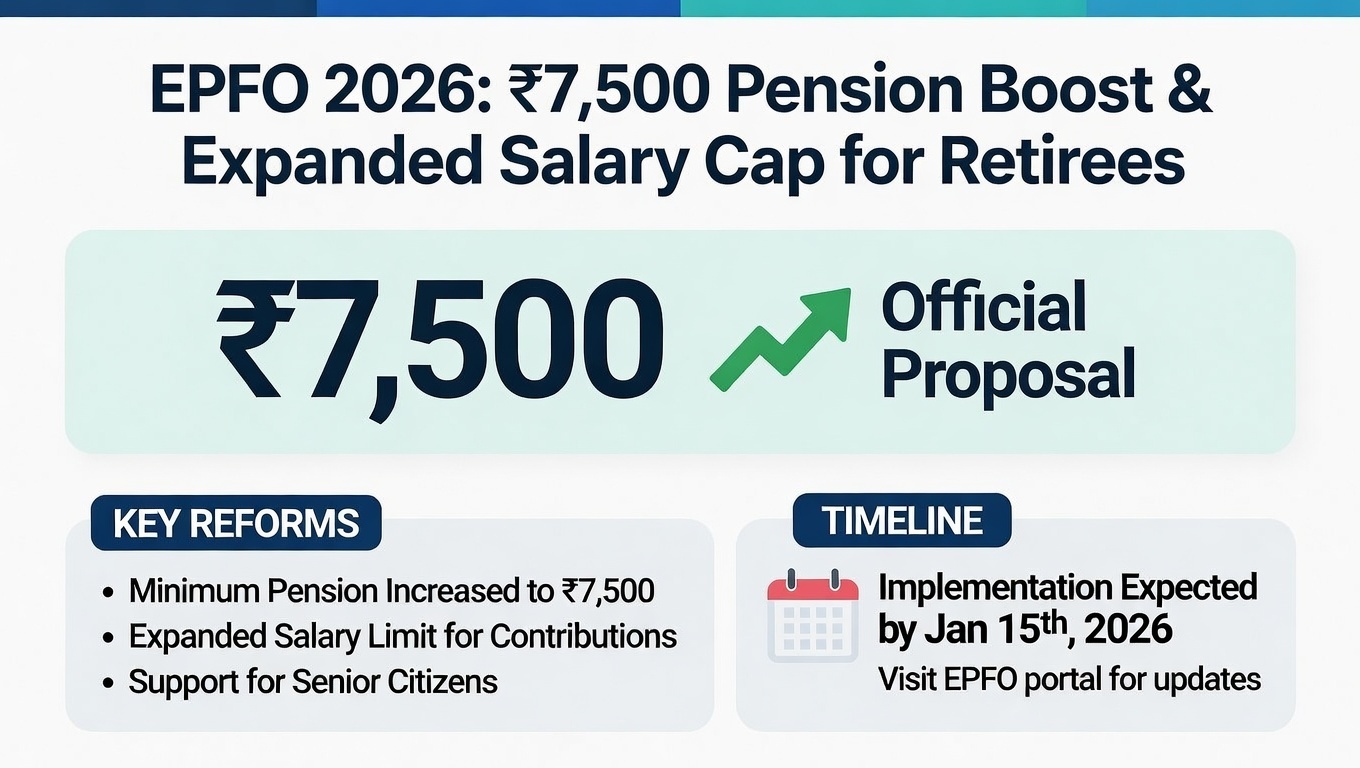
EPFO Pension 2026: ₹7,500 Minimum Pension Proposal & Higher Salary Limit Bring Big Relief to Retirees!

By gaurav

Published On:

The EPFO Pension 2026 update has once again brought retirement security into the national spotlight. For years, private sector retirees covered uner the Employees’ Pension Scheme (EPS) have struggled to manage daily expenses on a minimum pension of just ₹1,000 per month. In 2026, discussions around increasing this amount to ₹7,500 have gained momentum, reflecting growing concern about inflation, healthcare costs, and the dignity of senior citizens. These discussions are taking place at the policy level and involve inputs from pensioner associations, economists, and government officials.

+500
📢 अभी Join करें WhatsApp Group फ़्री ग्रुप में ज्वाइन करें!!
Join Now →

The proposal also includes revising the pensionable salary ceiling from ₹15,000 to ₹25,000 per month. This move is seen as an attempt to align pension calculations with current private sector wage realities. While no official notification has been issued yet, the issue has wide relevance as it Why the ₹7,500 Minimum Pension Demand Is Growing

The demand to raise the EPS minimum pension to ₹7,500 is rooted in everyday realities faced by retirees. When the ₹1,000 floor was introduced in 2014, it was considered a relief measure. Over time, inflation in food, housing, and medical services has significantly reduced its purchasing power. For many elderly pensioners, this amount barely covers basic monthly expenses, forcing dependence on family or additional income sources.

यह भी पढ़े:
Train Ticket Booking Timings to Change : Know the New Timings and Rules

Pensioner associations argue that ₹7,500 is not a luxury but a survival-level amount in today’s economy. Healthcare expenses, in particular, have risen sharply for senior citizens. Without adequate pension support, retirees risk financial insecurity during their most vulnerable years. The proposal is therefore framed as a social necessity rather than a generous welfare promise.

Salary Ceiling Revision and Its Long-Term Impact

The proposal to raise the pensionable salary ceiling from ₹15,000 to ₹25,000 could significantly reshape EPS benefits. Under the current structure, contributions beyond ₹15,000 do not count toward pension calculations, limiting future payouts even for mid-level earners. Revising this ceiling would allow pensions to better reflect actual earnings during service years.

However, a higher ceiling also means higher monthly contributions from both employers and employees. While this may slightly reduce take-home salary in the short term, supporters see it as a long-term investment in retirement security. Younger employees, in particular, stand to gain the most if the revised ceiling remains in place for several years.

यह भी पढ़े:
Fitment Factor Hike 2026: Big Salary Boost Expected Under 8th Pay Commission

Financial Sustainability and Policy Challenges

One of the biggest concerns surrounding the EPFO Pension 2026 proposal is financial sustainability. Increasing the minimum pension to ₹7,500 would multiply pension outgo several times over. Without adequate funding mechanisms, this could strain the pension corpus and create long-term liabilities for the system.

Economists stress the importance of actuarial balance. Any reform must ensure that contributions, returns, and government support are sufficient to meet future obligations. Policymakers are therefore expected to weigh social welfare goals against fiscal discipline. A phased increase or partial government subsidy is also being discussed as a possible compromise.

What the Proposed Changes Mean for Workers

For low-income retirees, the proposed pension hike could be life-changing. A higher minimum pension would provide stability and reduce dependence on family support. Workers nearing retirement are particularly hopeful that reforms will be implemented before they exit the workforce, allowing them to benefit directly from the revised structure.
यह भी पढ़े:
Cabinet Approves 3% DA Increase – Good News for Central Employees &Pensioner

Younger employees may view the changes differently. While higher contributions may seem burdensome initially, they also promise better post-retirement income. Financial planners continue to advise workers not to rely solely on EPS and to complement it with options like the National Pension System or long-term investments.

Implementation Timeline and Government Signals

At present, there is no confirmed timeline for implementing the EPFO Pension 2026 proposals. Any formal change would require amendments, official notifications, and budgetary allocation. Past experience suggests that pension reforms often take time and may be introduced in stages rather than all at once.

Government signals so far indicate cautious consideration rather than immediate approval. With competing fiscal priorities, the final decision will likely depend on broader economic conditions and revenue projections. Pensioners and employees alike are advised to follow official announcements closely for clarity.

यह भी पढ़े:
Pension Scheme: In a major move to support vulnerable sections of society, the Indian government has announced a significant increase in pension benefits for widows, senior citizens, and differently-abled individuals. Rising inflation and the growing cost of living have made it difficult for many to meet their daily needs, especially those without a stable income. To address this issue, the new Widow, Senior Citizen & Disabled Pension Scheme 2025 aims to ensure financial security, dignity, and independence for millions of beneficiaries across the country. Under the latest update, eligible widows and citizens above 60 years of age will now receive ₹4,000 per month, while differently-abled persons will get between ₹6,000 and ₹10,000 monthly, depending on the severity of disability. This decision marks one of the biggest welfare boosts in recent years, offering real relief to people who rely on pensions for survival. The initiative also focuses on creating equality by standardizing pension amounts nationwide, ensuring no one is left behind regardless of where they live. Equal Pension Benefits Across All States One of the most important aspects of the new pension scheme is the elimination of state-level disparities. Until now, pensions differed across states, leaving many underprivileged individuals struggling with low monthly payments. This unified system ensures every citizen, regardless of region, receives fair and equal support. For instance, a widow living in a small village will now receive the same pension as one living in a metropolitan city. This change is being hailed as a step toward social equality and inclusive growth. It not only brings uniformity but also simplifies the administration of pensions. State governments will coordinate with central authorities to ensure smooth implementation. For beneficiaries, this means greater financial predictability and a sense of security in old age or during difficult times. Online Application Process Made Simple To make the process more accessible, the government has introduced a completely online application system. Applicants no longer need to visit government offices or stand in long queues. They can now apply for the pension directly from home through the official portal using a smartphone or computer. This user-friendly platform allows beneficiaries to upload required documents, track their application, and receive updates easily. For those who are not familiar with online systems or live in remote areas without internet access, local facilitation centers have been established. These centers provide assistance with document uploads and online submissions. The new digital model also minimizes paperwork, reduces delays, and ensures that applications are verified and approved faster than before. Direct Benefit Transfer for Transparency One of the key strengths of the revised pension scheme is the Direct Benefit Transfer (DBT) mechanism. Under this system, the pension amount is deposited directly into the beneficiary’s bank account each month. This reduces the chances of fraud, leakage, or delay, ensuring that every eligible individual receives their due amount promptly and securely. To access the benefit, applicants must ensure their bank accounts are linked with their Aadhaar numbers. The government’s integration of DBT not only enhances transparency but also builds trust among citizens. Especially for elderly or differently-abled people in rural areas, this method eliminates the need to travel or depend on intermediaries, making financial support accessible at their doorstep. Financial Relief Amid Rising Living Costs The increase in pension comes at a time when essential items like groceries, healthcare, and medicines are becoming more expensive. For widows and senior citizens who often rely solely on pensions, the revised amount of ₹4,000 to ₹10,000 per month can make a substantial difference. It provides them the ability to manage expenses independently without having to depend entirely on family or neighbors for daily needs. This reform also benefits families caring for elderly or differently-abled members. With a higher and more consistent pension amount, households will face less financial strain. The scheme not only supports individual beneficiaries but also contributes to reducing poverty and promoting social welfare across the nation. Documents Required for Pension Application The online application process requires certain essential documents to verify eligibility. These include an Aadhaar card, bank passbook, and residence proof. Additionally, specific certificates are needed depending on the category. Widows must submit the death certificate of their husband, senior citizens must provide age proof (such as a birth certificate or voter ID), and differently-abled applicants must upload a valid disability certificate issued by a government authority. Once all required documents are uploaded and verified by officials, the pension will start getting credited directly into the beneficiary’s bank account. The entire process has been designed to be fast, transparent, and convenient. Applicants are advised to ensure all details are correct and up to date to avoid any delays in receiving payments. Government’s Vision for Inclusive Welfare This updated pension scheme aligns with the government’s broader mission of inclusive development and social welfare. The long-term vision is to ensure that no citizen—especially the most vulnerable—is left behind. By making the system digital and nationwide, the government aims to promote transparency, equality, and economic security for all. Officials have also hinted that the pension amount could be revised periodically based on inflation and living costs. Such continuous improvement ensures that beneficiaries continue to live with dignity and financial stability. Overall, this reform reflects a strong commitment toward building a more equitable society where every individual can live with self-respect and confidence. Disclaimer: This article is intended for general informational purposes only. The details mentioned are based on available reports and official announcements as of now. Policies, amounts, and eligibility criteria may change in the future. Readers are advised to visit the official government website or contact local authorities for the latest and most accurate updates before applying for any pension benefit. Widow, Senior Citizen & Disabled Pension Scheme: Now Get ₹10,000 Every Month

Broader Implications for India’s Retirement System

The ongoing debate around EPFO pensions reflects a larger issue within India’s retirement framework. As life expectancy rises and family structures change, dependable pension income is becoming more important than ever. The private sector, in particular, lacks the assured benefits available to government employees.

If implemented thoughtfully, the proposed reforms could strengthen trust in the organised sector’s social security system. They may also set a precedent for future updates, ensuring that pensions remain relevant and adequate in a changing economic landscape.

Disclaimer

This article is based on ongoing discussions, policy reports, and publicly available information related to EPFO Pension 2026. No official notification has confirmed the ₹7,500 minimum pension or the ₹25,000 salary ceiling revision as of now. Readers are advised to rely only on official announcements from EPFO and the Government of India before making any financial or retirement-related decisions.

यह भी पढ़े:
Breaking News: DA Arrears 2026 Payment Timeline Out for All Govt Employees

Leave a Comment