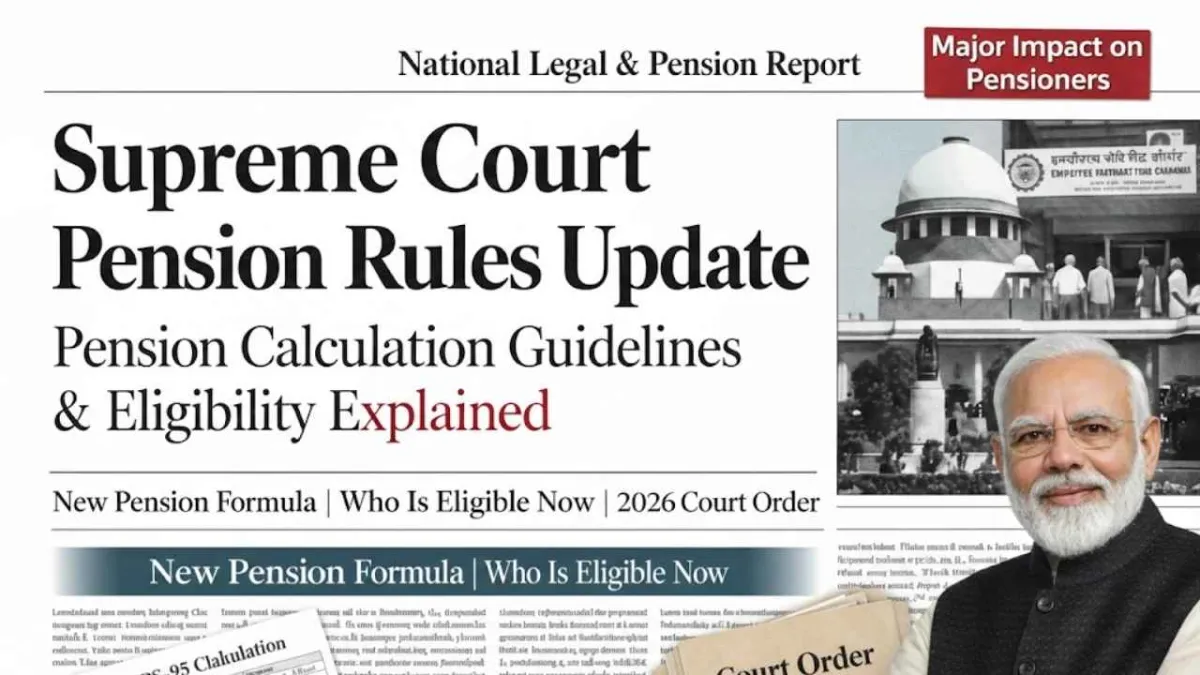
The Supreme Court Pension Rules 2026 have brought renewed attention to how retirement income is calculated for millions of private-sector employees in India. In recent observations, the examined long-standing concerns around pension payouts under the Employees’ Pension Scheme, widely known as EPS-95. These discussions matter because pensions are not just financial benefits; they are a lifeline for retirees who depend on monthly income to meet basic living expenses.
The issue has gained prominence in 2026 as inflation, rising healthcare costs, and longer life expectancy put pressure on fixed retirement incomes. Many retirees believe their pensions do not reflect what they actually contributed during their working years. The Supreme Court’s remarks have not introduced a brand-new pension scheme, but they have reopened debate on fairness, eligibility, and calculation methods. For employees approaching retirement and those already retired, understanding these pension rules is now more important than ever.
Understanding EPS-95 and Its Original Purpose
The Employees’ Pension Scheme was introduced in 1995 to provide long-term financial security after retirement, disability, or death. At that time, average wages were much lower, and the pension formula was designed to ensure basic income support rather than a full salary replacement. Contributions were shared between employers and employees, with a portion diverted from provident fund payments into the pension pool.

Over the years, the Indian workforce has changed significantly. Salaries have grown, job mobility has increased, and retirement needs have expanded. However, the core structure of EPS-95 has remained largely unchanged. This gap between modern income levels and older pension formulas is the reason why pension adequacy has come under scrutiny in 2026.
The Wage Ceiling Issue and Pension Calculation Limits
One of the most debated aspects of EPS-95 is the pensionable salary ceiling of ₹15,000 per month. Even if an employee earned more, pension calculations were often capped at this limit. As a result, workers with higher salaries feel their retirement benefits do not reflect their actual earnings or contributions made during service.
The Supreme Court has examined whether employees who opted to contribute on actual salaries should be treated differently. The key point is consent and documentation. Only those who can prove higher contributions, agreed upon by both employer and employee, may be eligible for recalculated pensions under existing rules.

Eligibility Criteria for Higher Pension Claims
Eligibility under the Supreme Court Pension Rules 2026 is not universal. Pension recalculation depends on whether the employee and employer jointly opted to contribute beyond the wage ceiling. This choice had to be made during employment and properly recorded with provident fund authorities.
Employees who retired years ago often face challenges in proving eligibility due to missing records or unreported salary components. Courts have emphasized that without clear evidence, claims cannot be approved. This makes document preservation and official filings crucial for anyone seeking higher pension benefits.
Role of Digital Records and EPFO Verification
Digitisation has transformed pension administration in recent years. Retirees can now access contribution histories, passbooks, and employer filings online. These digital records play a key role in verifying pension claims and resolving disputes related to salary ceilings and contribution amounts.
However, older employment periods remain problematic. Many companies did not maintain detailed digital records in the past. In such cases, pensioners may need salary slips, appointment letters, or employer confirmations. The EPFO has advised applicants to cross-check records before filing claims to avoid rejection.
Balancing Pension Adequacy and Financial Sustainability
Policy makers face a complex challenge in balancing adequate pensions with the long-term sustainability of pension funds. Increasing payouts for a large number of retirees could strain resources, potentially affecting future beneficiaries. This concern has been repeatedly raised during legal and policy discussions.
On the other hand, retirees argue that pensions should ensure dignity and financial independence. With rising living costs, a low monthly pension can quickly become insufficient. The Supreme Court’s observations reflect this tension, highlighting the need for fair yet sustainable pension practices.

What the Supreme Court Update Does Not Mean
It is important to clarify that the Supreme Court Pension Rules 2026 do not announce a universal pension hike. There is no automatic increase for all EPS-95 pensioners. Each case will be examined individually based on eligibility, contribution history, and compliance with existing rules.
Retirees are advised to rely only on official notifications and EPFO communications. Misleading claims circulating online can create false expectations. Understanding the limits of the current update helps pensioners make informed financial decisions without unnecessary stress.
Why This Pension Debate Matters in 2026
The renewed focus on EPS-95 highlights broader issues in India’s retirement system. As the workforce ages and life expectancy increases, the need for reliable and adequate pensions becomes more urgent. Court observations often act as catalysts for policy review and administrative reform.

For employees still in service, these discussions underline the importance of understanding contribution options early. Decisions made during employment can significantly impact retirement income. The 2026 pension debate serves as a reminder that awareness and documentation are essential for long-term financial security.
Disclaimer
This article is for informational purposes only. Pension rules, eligibility criteria, and calculation methods may change based on official government notifications or court decisions. Individual pension outcomes depend on contribution history, employer compliance, and documentation. Readers are advised to verify details with the EPFO or authorised sources before making any financial or retirement-related decisions.